
Cricket Scoring Rules: A Complete Guide for Players and Scorers

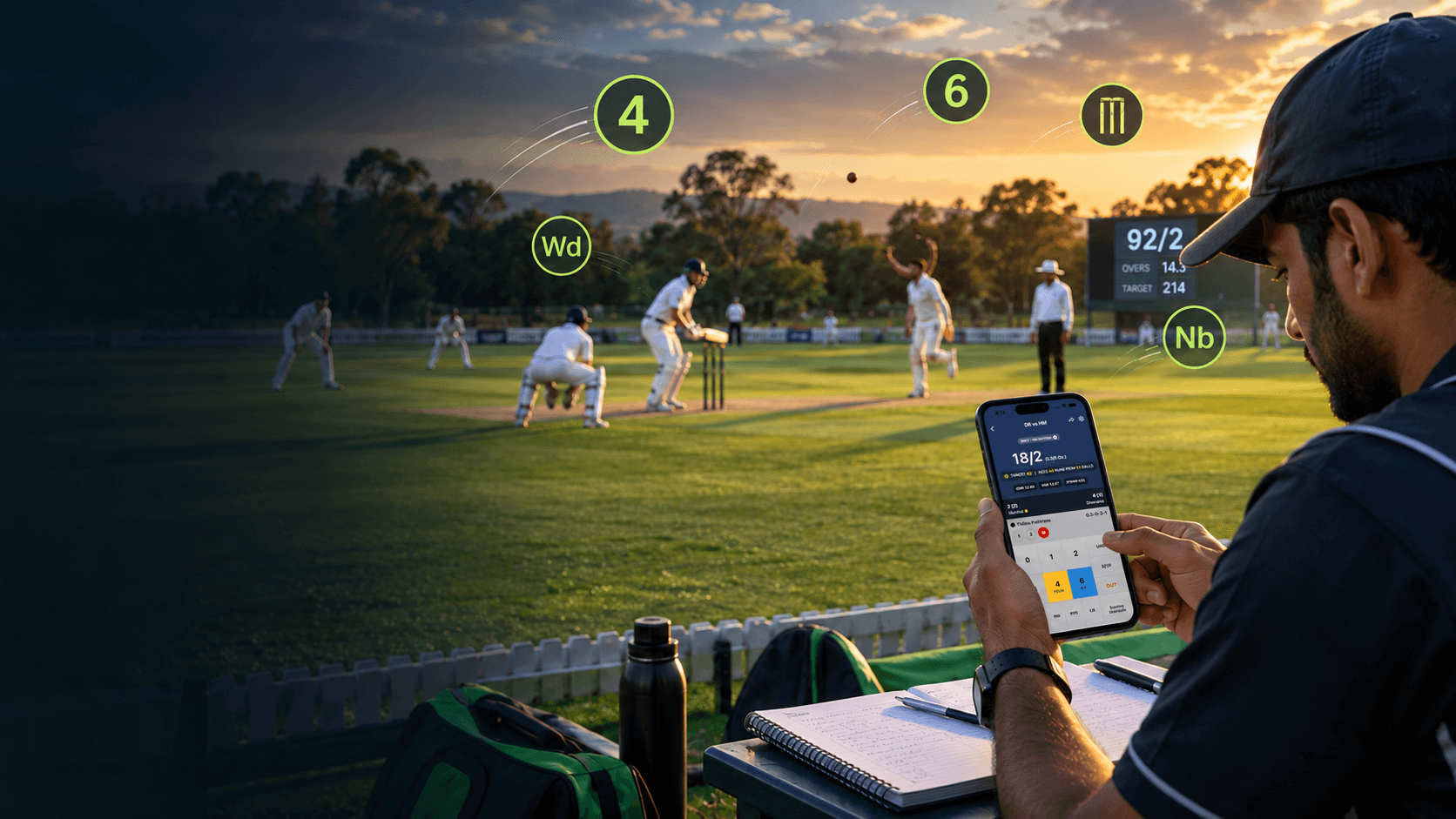
Cricket scoring rules explain how runs, wickets, legal deliveries, wides, no-balls and other match events are recorded. Understanding these rules is important for scorers, players, umpires, tournament organisers and cricket supporters.
Although cricket scoring may initially appear complicated, most match events follow a clear structure. Every delivery must be recorded correctly because one scoring error can affect the match result, player statistics, bowling figures, net run rate and tournament standings.
This guide explains the essential cricket scoring rules and shows how the MyCric live cricket scoring app can make community cricket scoring easier.
Important: This guide uses ICC Men’s T20I Playing Conditions as a reference. The MCC is the custodian of the Laws of Cricket, while the ICC applies format-specific playing conditions. Local tournaments may use modified rules, including different numbers of balls per over.
Cricket Scoring Rules: Understanding the Score
A cricket score shown as 145/6 means that the batting team has scored 145 runs and lost six wickets.
A complete cricket scorecard normally contains:
- Total team runs
- Wickets lost
- Overs completed
- Runs scored by each batter
- Balls faced by each batter
- Fours and sixes
- Batter strike rates
- Runs conceded by each bowler
- Wickets taken by each bowler
- Bowling economy rates
- Wides, no-balls, byes and leg-byes
- Fall of wickets
- Partnerships between batters
The team’s total includes runs credited to the batters and all extras awarded during the innings.
Readers can find more scoring guides and MyCric updates on the MyCric cricket blog.
How Many Balls Are in a Cricket Over?
According to standard ICC cricket scoring rules, one completed over contains six valid deliveries.
A wide or no-ball is not considered a valid delivery. Therefore, it does not count as one of the six balls, and the bowler must deliver an additional ball.
For example, imagine a bowler delivers:
- Six valid balls
- One wide
- One no-ball
The bowler has physically delivered eight balls, but the scorecard records only one completed over.
Some community competitions use four-ball or five-ball overs. MyCric allows organisers to configure the number of balls per over according to their tournament format. However, six valid deliveries remain the standard under the ICC Men’s T20I Playing Conditions.
Understanding over notation
Cricket over notation is not a decimal calculation.
- 12.0 means 12 completed overs.
- 12.1 means 12 overs and one valid ball.
- 12.4 means 12 overs and four valid balls.
- 12.5 means 12 overs and five valid balls.
- The next valid delivery changes the score to 13.0 overs.
Wides and no-balls do not increase the valid-ball number.
How Runs Are Scored in Cricket
Batters can score by running between the wickets or hitting a boundary.
Runs completed between the wickets
One run is completed when both batters safely make their ground at the opposite ends. They can complete two, three or more runs if the ball remains in play and they have enough time.
Boundary four
Four runs are normally awarded when a ball hit by the batter reaches or crosses the boundary after touching the ground.
Boundary six
Six runs are awarded when the batter hits the ball over the boundary without it first touching the ground inside the field.
Runs scored from the bat are added to:
- The batter’s individual score
- The batting team’s total
- The runs conceded by the bowler
Cricket Extras Explained
Extras are runs added to the team total but not always credited to the batter. Understanding extras is an important part of cricket scoring rules.
| Extra | Runs awarded | Valid ball? |
|---|---|---|
| Wide | One penalty run plus additional completed runs | No |
| No-ball | One penalty run plus runs scored or completed | No |
| Bye | Runs completed without the ball touching the bat or batter | Yes |
| Leg-bye | Runs after the ball touches the batter under permitted conditions | Yes |
| Penalty | Usually five runs for specified infringements | Depends on incident |
How to Score a Wide
A delivery may be called wide when it passes outside the batter’s reach under the applicable playing conditions.
The batting team receives one automatic wide run. If the ball reaches the boundary or the batters complete additional runs, those runs are also recorded as wides.
A wide does not count as a valid delivery.
For example, when a wide reaches the boundary without being touched, the batting team normally receives five wides:
- One run for the wide penalty
- Four additional wide runs
All five runs are added to the team total and recorded against the bowler.
How to Score a No-Ball
The batting team receives one penalty run when the umpire calls a no-ball. Any additional runs scored from the delivery are added to that penalty.
A no-ball does not count as a valid delivery, and a no-ball call overrides a wide.
What happens when a no-ball is hit for six?
When the batter hits a no-ball for six, the batting team receives seven runs:
- Six runs credited to the batter
- One no-ball extra
- Seven runs added to the team total
- Seven runs normally recorded against the bowler
Under ICC T20I conditions, the next delivery after a no-ball is a free hit. If the free-hit delivery is another no-ball or wide, the free hit continues to the following delivery.
Local competitions should confirm whether they have adopted the free-hit condition before the match begins.
How Byes and Leg-Byes Are Scored
A bye can be recorded when a legal delivery passes the striker without touching the bat or the batter’s body and the batters complete runs.
A leg-bye may be awarded when the ball touches the batter’s body and the batter has:
- Attempted to play a shot, or
- Attempted to avoid being hit by the ball
If the batter does neither, leg-byes should generally not be awarded.
Byes and leg-byes increase the team total, but they are not credited to the batter. They are also not normally charged against the bowler’s bowling figures.
How Wickets Are Recorded
When a batter is dismissed, the scorer must record the dismissal method and the players involved.
Common dismissal types include:
- Bowled
- Caught
- Leg before wicket
- Run out
- Stumped
- Hit wicket
- Obstructing the field
- Hit the ball twice
Not every dismissal is credited to the bowler. A run-out, for example, increases the number of team wickets lost but is not recorded as a wicket taken by the bowler.
Can a batter be dismissed from a no-ball?
A batter cannot be dismissed from a no-ball through most standard dismissal methods. However, dismissals such as run out, obstructing the field and hitting the ball twice can still apply.
The scorer should always follow the umpire’s final signal when recording a wicket.
What Does Retired Hurt Mean?
A batter may retire while the ball is dead after the umpires have been informed.
When a batter retires because of injury, illness or another unavoidable reason, the batter may be permitted to return later. If the batter cannot resume the innings, the scorecard records the batter as retired not out.
Retirement for another reason can be treated differently. Under ICC T20I playing conditions, it may result in the batter being recorded as retired out unless permission to resume the innings is granted.
How Is a Cricket Target Calculated?
The team batting second must score one run more than the first team’s total to win.
If the first team scores 170, the second team’s winning target is 171.
During a run chase, the scorecard may display:
- Target score
- Runs required
- Balls remaining
- Required run rate
- Current run rate
- Wickets remaining
If both teams finish with the same score, the match is tied. A Super Over may be used when it is included in the competition’s playing conditions.
Why Accurate Cricket Scoring Rules Matter
Correct cricket scoring rules protect the integrity of the match and the accuracy of player records. One incorrectly counted delivery can change the required run rate, bowling economy, batter strike rate and final result.
Accurate scoring is especially important during tournaments because results can affect:
- Team standings
- Net run rate
- Qualification
- Top-scorer awards
- Leading-wicket-taker awards
- Most valuable player calculations
- Career statistics
Digital cricket scoring reduces the need for organisers to manually rebuild scorecards after every match.
How MyCric Makes Cricket Scoring Easier
MyCric helps scorers apply cricket scoring rules while creating an organised digital record of every match.
MyCric provides:
- Live ball-by-ball scoring
- Four, five or six-ball over configuration
- Runs, wickets and extras recording
- Batter and bowler statistics
- Digital match scorecards
- Tournament and fixture management
- Team and player registration
- Offline scoring support
- Player career statistics
- OBS and vMix broadcast overlays
- Live match updates for supporters
Tournament organisers can use MyCric to manage fixtures, score matches and maintain player statistics within one cricket platform.
Download the MyCric cricket scoring app and start scoring your next match.
- Download MyCric for Android
- Download MyCric for iPhone and iPad
- Download MyCric from Huawei AppGallery
Frequently Asked Questions About Cricket Scoring Rules
How many legal balls are in an over?
A standard cricket over contains six valid deliveries. Wides and no-balls are not counted as valid balls.
Does a wide count as a ball faced?
A wide does not count as a valid team delivery. Whether it affects an individual balls-faced statistic can depend on whether the ball made contact under the applicable scoring rules.
Does a no-ball count in the bowler’s over?
No. A no-ball does not count as one of the six valid deliveries, so the bowler must deliver another ball.
How many runs are awarded for a no-ball hit for six?
Seven runs are added: six to the batter and one no-ball extra.
Is retired hurt counted as a wicket?
No. A batter who retires because of injury, illness or another accepted unavoidable reason is recorded as retired not out if the batter does not resume the innings.
Start Scoring with MyCric
Learning cricket scoring rules helps scorers, players and supporters understand every stage of a match. Each run, extra, wicket and valid delivery must be recorded correctly to produce an accurate scorecard.
For an easier way to score local cricket, manage tournaments and maintain player statistics, start using MyCric today.
Related Guides & Articles
View all articles →
MyCric vs CricHeroes vs CricClubs: Which Cricket Platform Is Right for Your Team?
Compare MyCric, CricHeroes and CricClubs for grassroots cricket scoring, team management, posters, live coverage and overall value.
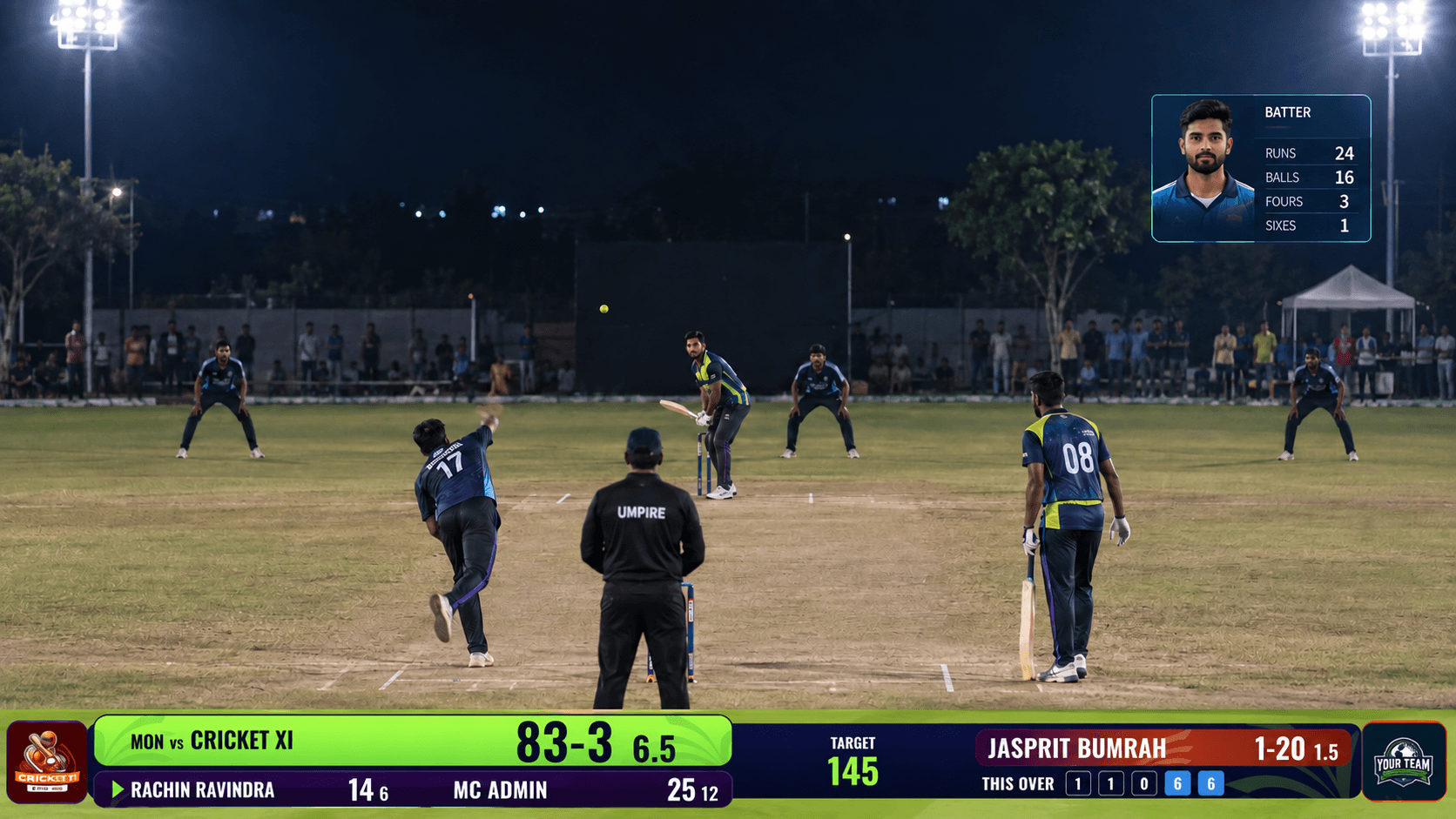
How to Get TV-Quality Broadcast Overlays for Grassroots Cricket
Learn how grassroots cricket tournaments can use live scoring, OBS or vMix, and professional cricket broadcast overlays to deliver a TV-quality stream.
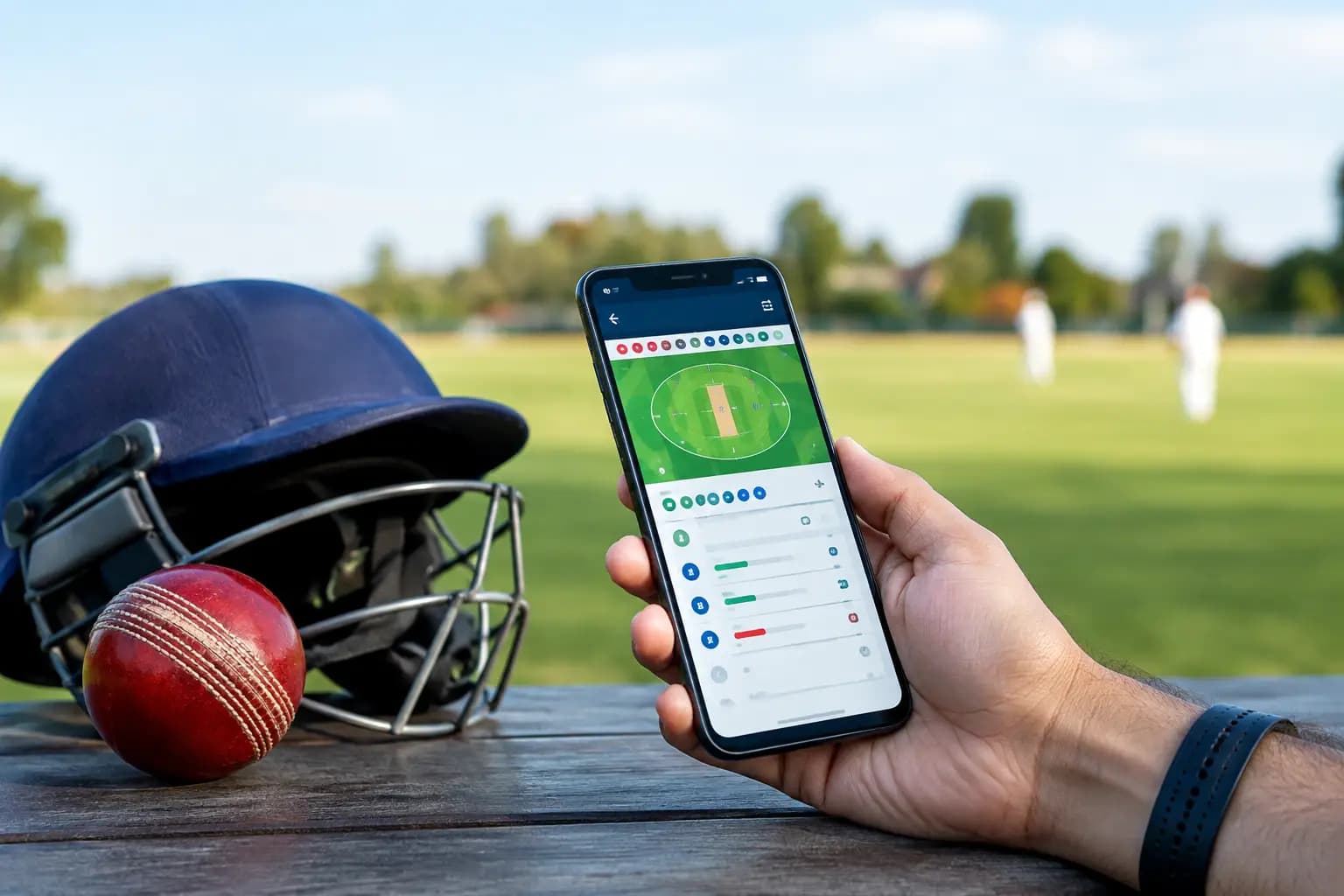
Cricket Scoring App MyCric.app for Match Days
A close local match can turn on one detail: a missed wide, an incorrect run-out entry, or a score that no one can verify after the final ball….